David Ding
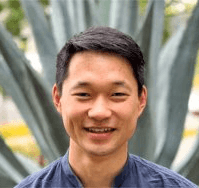





I'm a NSF postdoc at UC Berkeley (+Dave Savage) creating commercially viable solutions to climate change.
How I got here: Systems Biology PhD at MIT/Harvard (+Mike Laub and Debbie Marks), Biochemistry & Functional Genomics at Oxford University, born in Austria and raised by scrappy Chinese immigrants.
Scaling biology for a biosynthetic future
1) ML-designed enzymes for material production at scale with predictable economics.
With the billions & billions of actual and soon to exist enzymes, why isn't everything made using biology? Learning from the early attempts of bio-fuels and materials, I create bespoke high-throughput datasets to power machine learning and process design efforts to enable a sustainable future.
For example, together with members of the Debora Marks, Jill Banfield and David Baker lab, I work on engineering carbonic anhydrase for industrial conditions, such as direct air capture and our built environment.
2) Discovering molecular tools from extremophiles.
There are certain paradigms of how life works, but we really only know about normal conditions. How is a whole proteome rewired to adapt to life at 100C or possibly even 250C? I believe we've only scratched the surface of the paradigm shifts and molecular tools, and are mining these organisms with Jill Banfield.
3) Gene editing for next generation sustainable crops.
Agriculture has scale, but with breeding we're only slowly inching our way towards possible photosynthetic efficiencies. We produce high-throughput data to realize the potential of gene editing for a sustainable future using timely crop improvements.
Past Research
You don't need $$$ and billions of parameters to model protein evolution.
I discovered that simple regression models can fit and predict in some cases almost perfectly which mutations are tolerated next. This also enabled us to use equivariant graph convolutional neural networks to learn mutational preferences and make predictions just from the surrounding context of a protein site. paper, talk.
What makes biological systems evolvable?
Unlike man-made systems, biological systems have a profound ability to evolve, ie. generate functional novelty. But how does random recombination and mutation produce living and completely new offspring? In grad school, I developed systematic assays and Bayesian inference models to map and predict how proteins can do this. paper, news&views.
What does the 95% of noncoding human genome do?
When I studied biochemistry at Oxford, it was clear that the future would not be in individual, pain-staking measurements, but systematic ones offered by genomic technologies. I ended up building analysis pipelines for understanding the disease contribution of the non-coding human genome. paper.
Other interests
What's the future of knowledge work?
Decision making is computation on what surfaces from the subconscious. But how do you load the right, but very limited information? I'm exploring options to tap into not just personal but the sea of the world's knowledge, and enable conscious control over what is loaded.
Unconventional approaches to changing minds about sustainability: Veganali
Other: I love having the limits of my expectations blown also outside of research, whether during Muay Thai, surfing, half ironmans, or being a dad.